
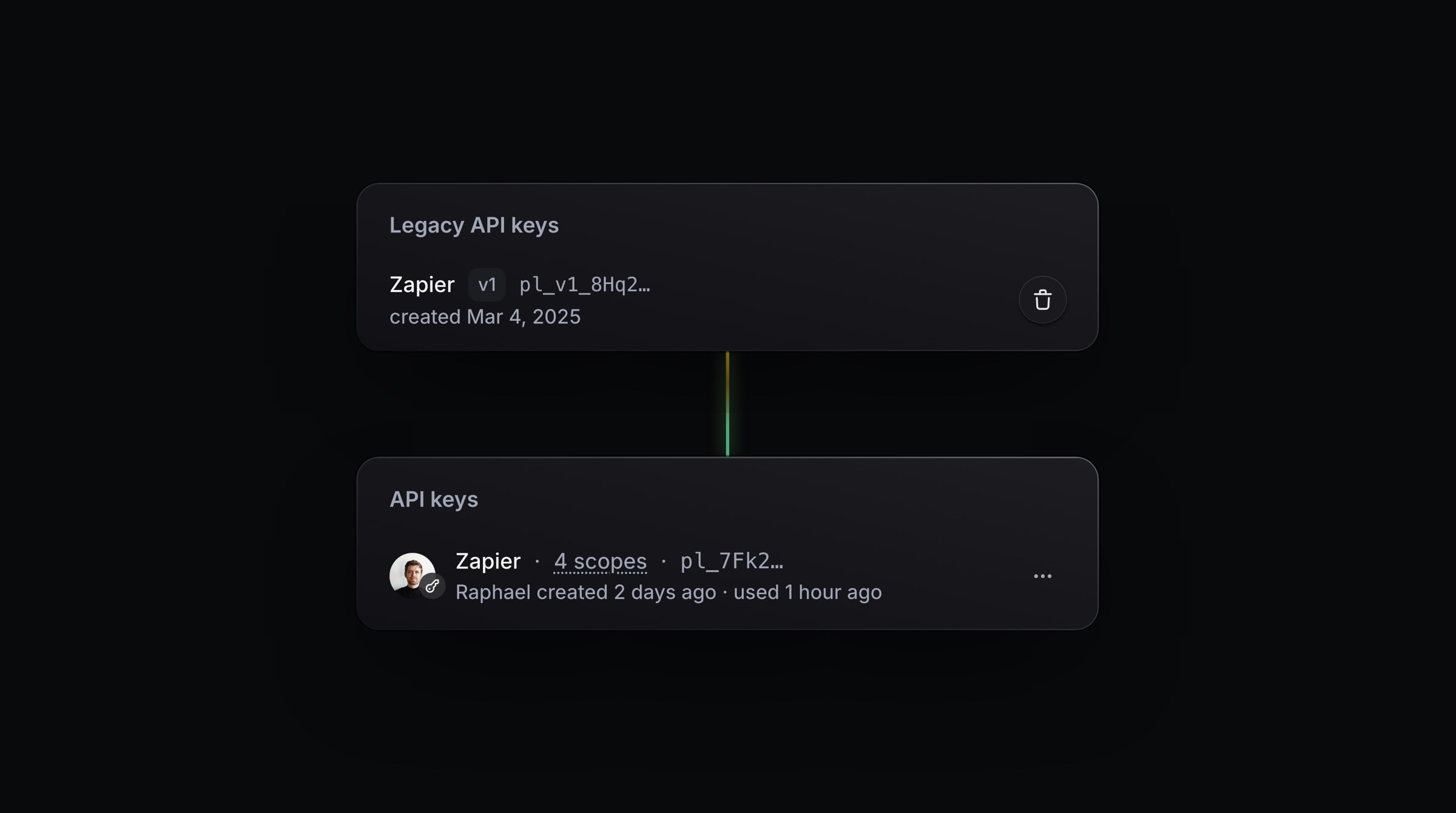
We removed API v1 on November 20, 2026. API v2 is now the only version. Update any v1 calls with this guide.
If you're integrating for the first time, skip to v2.
What changed
| Area | v1 | v2 |
|---|---|---|
| Base URL | https://productlane.com/api/v1 |
https://productlane.com/api/v2 |
| API keys | pl_v1_* (Unkey) |
pl_v2_* (mint a new one - secrets shown once) |
| Workspace id | In path on some endpoints | Always inferred from key |
| Field naming | Mixed camel/snake | snake_case everywhere |
| Dates | superjson-wrapped Date |
ISO 8601 strings |
| Thread state | state: NEW/PROCESSED/COMPLETED/SNOOZED/UNSNOOZED |
status: open/snoozed/done + read-only tab |
| Pagination | Mixed (offset / bare arrays) | Cursor on every list: { data, page: { cursor, has_more, limit } } |
| Errors | Raw tRPC shape | { error: { code, message, details?, request_id } } + X-Request-Id header |
| Webhooks | None | HMAC-signed deliveries, 6 retries |
| Scopes | Full access | Per-key scopes (threads:read, admin, …) |
| Rate limits | None | 1000 reads/min, 60 writes/min, headers exposed |
Thread status mapping
v1 state |
v2 status |
Notes |
|---|---|---|
NEW |
open |
Setting open on a NEW thread keeps it NEW (inbox "new" tab stays intact) |
UNSNOOZED |
open |
|
SNOOZED |
snoozed |
snoozed_until is required |
PROCESSED |
done |
|
COMPLETED |
done |
Send closed_loop: true to mark as COMPLETED |
Endpoint changes
| v1 | v2 |
|---|---|
GET /threads/{id}?includeConversation=true |
GET /threads/{id}?expand=messages,comments |
| n/a | GET /threads/{id}/messages, GET /threads/{id}/comments |
GET /contacts/{idOrEmail} |
GET /contacts/{id} or GET /contacts/by-email?email=… |
GET /companies/by-external-id/{wksId}/{extId} |
GET /companies?external_id=… |
GET /changelogs/{workspaceId} |
GET /changelogs |
GET /docs/articles/{workspaceId} |
GET /docs/articles |
| n/a | GET /me, GET /members, GET /portal/*, POST /webhooks |
Concrete before/after
# Create a thread
- POST /api/v1/threads
- { "painLevel": "HIGH", "contactEmail": "[email protected]", "state": "NEW" }
+ POST /api/v2/threads
+ { "pain_level": "HIGH", "contact_email": "[email protected]", "status": "open" }

# List threads
- GET /api/v1/threads?workspaceId=wks_abc&state=NEW&take=50&skip=0
+ GET /api/v2/threads?status=open&tab=new&limit=50

# Snooze
- PATCH /api/v1/threads/thr_123  { "state": "SNOOZED", "snoozedUntil": "..." }
+ PATCH /api/v2/threads/thr_123  { "status": "snoozed", "snoozed_until": "..." }

# Contact by email
- GET /api/v1/contacts/[email protected]
+ GET /api/v2/contacts/[email protected]

# Company by external_id
- GET /api/v1/companies/by-external-id/wks_abc/crm-1
+ GET /api/v2/companies?external_id=crm-1
Removed thread fields
Gone from responses (they leaked internals): version, yDocText, linearAttachmentId, recordingId, slackReplyId, chatThreadId, replied, slaDeadlineAt, showRecordCall, contactIsUnverified, isDeleted, workspace, workspace.slackSettings. Per-integration ids (intercomId, frontId, …) are now under integration_ids. external_ids is a caller-owned list you set yourself, matching companies.
Error envelope
{
  "error": {
    "code": "validation_failed",
    "message": "Validation failed: title is required.",
    "details": [{ "path": "title", "message": "Required" }],
    "request_id": "req_3727ca7b4f0fff3c"
  }
}
Common codes: validation_failed (400), unauthenticated (401), scope_required (403), not_found (404), conflict (409), unsupported_key_version (410 - passed a v1 key), rate_limited (429), internal_error (500).
What did not change
Bearer token auth, pain levels (HIGH/MEDIUM/LOW/UNKNOWN), JSON bodies, HTTP status semantics.
Migrate with AI
Paste this prompt into Claude/Cursor/Copilot to apply the migration to your codebase:
You are migrating a codebase from Productlane API v1 to v2.

# Scope

Find every call to `https://productlane.com/api/v1` (or any path starting with `/api/v1`) and rewrite it for v2. Touch only request construction and response parsing - don't refactor surrounding business logic.

# Rules

1. **Base URL**: `/api/v1` → `/api/v2`.
2. **API key**: replace any `pl_v1_*` key references with the env var the project uses for the v2 key (ask if unclear; do not invent one). If a v1 key is hardcoded, leave a `TODO` comment.
3. **Drop `workspaceId` from paths.** Examples:
   - `GET /changelogs/{workspaceId}` → `GET /changelogs`
   - `GET /docs/articles/{workspaceId}` → `GET /docs/articles`
   - `GET /companies/by-external-id/{workspaceId}/{externalId}` → `GET /companies?external_id={externalId}`
4. **Field casing**: convert every request body field and every response field read from v2 endpoints to `snake_case` (`painLevel` → `pain_level`, `contactEmail` → `contact_email`, `lastInboundMessageAt` → `last_inbound_message_at`, `imageUrl` → `image_url`, etc.).
5. **Dates**: remove any superjson `Date` wrapping - v2 sends/receives ISO 8601 strings. Replace `{ __type: "Date", value: ... }` with the string.
6. **Thread `state` → `status`** with this mapping when writing:
   - `NEW`/`UNSNOOZED` → `"open"`
   - `SNOOZED` → `"snoozed"` (must include `snoozed_until` ISO 8601 string)
   - `PROCESSED` → `"done"`
   - `COMPLETED` → `"done"` + `closed_loop: true`
     When reading, map `tab`/`status` back to whatever internal representation the caller uses. Don't read `state` from v2 responses - it isn't there.
7. **Pagination**: rewrite list-call loops.
   - v1 shape `{ items, nextPage, hasMore, count }` (or bare array for changelogs) → v2 shape `{ data, page: { cursor, has_more, limit } }`.
   - Loop until `page.has_more === false`, passing `?cursor=<previous page.cursor>` on each next call. Drop `skip`/`take`; use `limit` (default 50, max 200).
8. **Single thread + conversation**: `GET /threads/{id}?includeConversation=true` → `GET /threads/{id}?expand=messages,comments`. If the call only needs the thread, drop the param entirely.
9. **Get-thread doesn't include messages/comments by default.** If code was relying on them being there without `includeConversation`, add the `expand=messages,comments` param OR switch to dedicated `GET /threads/{id}/messages` / `GET /threads/{id}/comments` (paginated).
10. **Contact lookup**: `GET /contacts/{idOrEmail}` splits.
    - If the value looks like an email (contains `@`) → `GET /contacts/by-email?email={value}`.
    - Otherwise → `GET /contacts/{id}` unchanged.
11. **external_ids and company domains** on PATCH replace the full array. `external_ids` is writable on companies, threads and contacts. If code intends to append, fetch first, append, then PATCH.
12. **Contact create/update**: at most one of `company_id`, `company_name`, `company_external_id`. If the v1 call passes more than one, keep `company_id` (or whichever the existing code seems to prefer) and drop the others.
13. **Removed thread fields**: stop reading any of these from v2 responses: `version`, `yDocText`, `linearAttachmentId`, `recordingId`, `slackReplyId`, `chatThreadId`, `replied`, `slaDeadlineAt`, `showRecordCall`, `contactIsUnverified`, `isDeleted`, `workspace`, `workspace.slackSettings`. Replace per-integration ids (`intercomId`, `frontId`, `hubspotId`, `plainId`, `zendeskId`, `productboardId`, `slackChannelId`) with `integration_ids.{intercom,front,hubspot,plain,zendesk,productboard,slack_channel}`.
14. **Error handling**: every v2 error body has shape `{ error: { code, message, details?, request_id } }`. If existing code parses tRPC-style errors, replace with `body.error.code` / `body.error.message`. Add the `X-Request-Id` header to any log lines that log the error.
15. **Rate limits**: where existing code retries, respect `Retry-After` on `429 rate_limited`. If there's no retry logic, don't add it - leave a `TODO` comment instead.
16. **Don't add features**: no new webhook handlers, no new scope checks, no new endpoints. Only migrate calls that exist.

# Process

1. Run a search for `/api/v1`, `pl_v1_`, `painLevel`, `state: "NEW"`, `state: "SNOOZED"`, `state: "PROCESSED"`, `state: "COMPLETED"`, `state: "UNSNOOZED"`, `includeConversation`, `nextPage`, and `superjson` to find all call sites.
2. For each site, apply the rules above. Keep changes minimal and local.
3. Where the v1 behavior was ambiguous (e.g. callers reading removed fields), leave a `TODO(productlane-v2): …` comment explaining what manual decision is needed. Don't guess.
4. After changes, re-run the search above to confirm nothing v1-shaped remains.
5. Print a short summary: files changed, call sites migrated, TODOs left.

Start now.